The Racial Justice Team, part of the South Carolina Synod’s Inclusiveness Network, sponsored a Civil Rights Tour to Atlanta, Georgia, September 15-16, 2026.
Thirty-five people – lay leaders, deacons, pastors and a bishop – experienced this journey of learning, building relationships, and sharing stories.
Here are five reflections.
Sister D’Etta Broam
It was a gift to be a part of our synod’s Civil Rights Tour of Atlanta. I look forward to the time we gather as the thirty-five tour members to have more conversation about what we experienced. I am hopeful this pilgrimage renews and strengthens us to share God’s love.
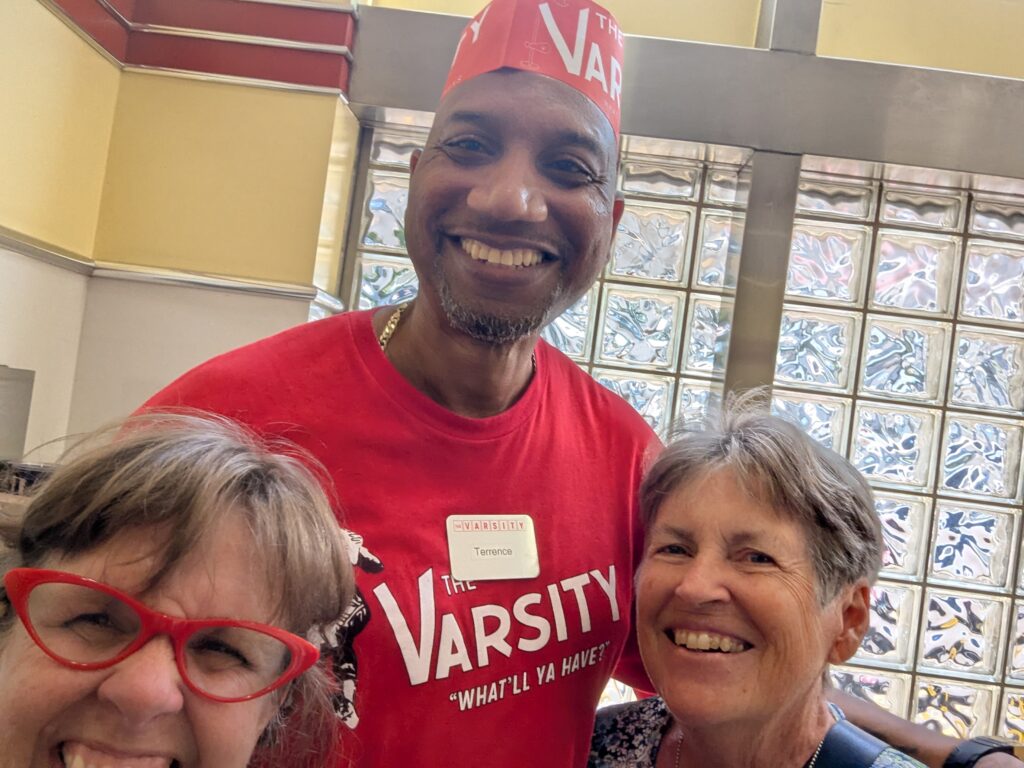
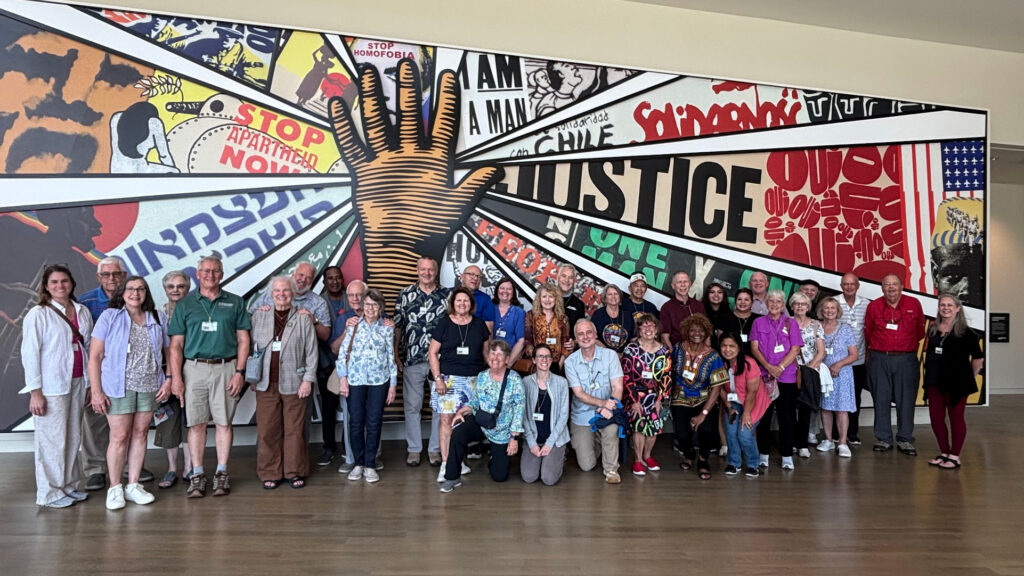
After a hamburger and fries lunch at the iconic Varsity restaurant, we first toured the National Center for Civil and Human Rights in downtown Atlanta. We gathered for a picture under the graphic that graced our tour name tags, and then, for the next three hours, we were free to wander and wonder at our own pace through the exhibitions for Civil Rights, Reconstruction, Soccer and Human Rights, and Global Human Rights. There were pictures, videos, music, creative displays, interactive experiences~so many ways to be immersed in our shared history. We had the opportunity to sit-in at a lunch counter, hear voices of Freedom Riders and those imprisoned for protests, be a part of the March on Washington, see horrific images and be right in the middle of heartbreaking memories of others. I learned not one woman was allowed to speak at the March on Washington. I did not know lynchings were nationwide and a form of entertainment. Postcards were created as gruesome souvenirs. It was dumbfounding. It was brutal to hold. It was not so long ago. It still happens today. It was real.
“Not everything faced can be changed, but nothing can be changed until it is faced”
~James Baldwin
I am thankful we were able to lament together as the body of Christ called to be the hands and feet of God. I pray the discomfort and pain we witnessed calls us to action to find new ways to be the church in a world that is changing and evolving and yet stuck fast in patterns of “it’s-not-my-problem,” greed, power, pride, and defensiveness.
”History, despite its wrenching pain cannot be unlived, but if faced with courage, need not be lived again”
~Maya Angelou
One of the surprises for me was how the family of Martin Luther King, Jr. continued to fight for injustice. There were pictures displayed of their imprisonment for protests against South African Apartheid in the 1980s. The pictures were no longer black and white, but in full color . . . the legacy of King lived on boldly and vibrantly.
‘What do you do in the moment of recognized privilege?” This was a question posed at a meeting recently that touched my heart. May we recognize and promote human rights. May we identify and challenge injustice. May we love as God has loved us. Amen and Amen.
Sister D’Etta Broam
Nicol & Juana Flores, Sagrada Familia Lutheran Church
(picture: mlk)
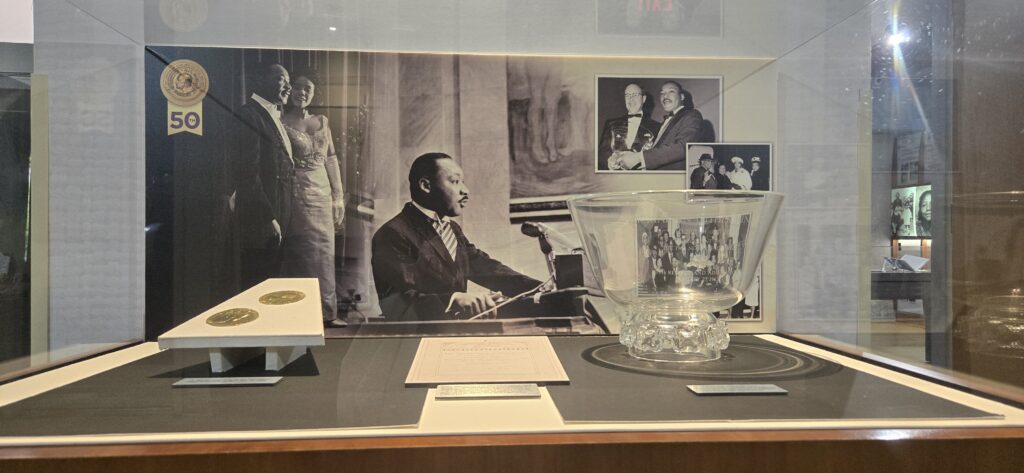
Firstly, we want to thank you for accepting us in the group and for how great we were treated.
Even though we knew a lot about Martin Luther King Jr. and the civil rights movement, there was a lot of new shocking information that we learned. One example is the impact of the huge number of people that followed him. Some other new information that we learnt at the Ebenezer Baptist Church was about how some of the deaths in Martin Luther King Jr.’s family happened. The audios we heard at the National Center for Civil and Human Rights were very impactful, you could feel like you were there and it makes you think about how scary it was for some people that were living through that. We didn’t realize how big an impact Rosa Parks had on the civil rights movement. We also didn’t know how much of an impact Mahatma Gandhi had on Martin Luther King Jr. it was also nice to learn about the many nonviolent believers and protestors.
At the Jimmy Carter Presidential Library & Museum we also learned a lot about President Jimmy Carter and the impact he had in the civil and human rights movement and all the struggles he went thought as president. Even after he finished his presidency and wasn’t reelected, he continued dedicating himself to mediating internal conflicts and supporting humanitarian causes.
Thank you so much,
Andres Leone
Reflection: What Will I carry with me?

Day #1
Today, a group of us from the South Carolina Synod of the ELCA traveled to Atlanta, and on this first day, we visited the Center for Civil and Human Rights.
What made the experience especially meaningful was not only what we saw and learned, but who we experienced it with.
Pastors, lay leaders, and members from congregations across South Carolina. Some born and raised in this part of the country, others who came here from different nations. Caucasian, Latino, African American, Asian. Different stories, different backgrounds, different experiences, gathered together in one place.
And as we walked through the stories of our history, we were reminded of something deeply important:
We cannot build a better future if we are unwilling to remember the past.
History is not simply a collection of things that happened long ago. It is a mirror.
It asks us to look honestly at the ways human beings have treated one another, at the injustices that were tolerated, at the voices that were silenced, and at the people who stood up and said, “This is not right.”
And perhaps most importantly, it asks us to consider ourselves.
Where have I benefited from a privilege that someone else did not have?
Where have I remained silent when I should have spoken?
Where might I have been part of a system that made life easier for me while making it harder for someone else?
Those are not always comfortable questions
But perhaps faith is not meant to make us comfortable.
We are called to love our neighbors.
Not just the neighbors who look like us, think like us, worship like us, or come from the same place.
Our neighbor is the person in front of us.
The person whose story we may not understand.
The person whose suffering may never have been our own.
And loving our neighbor means more than feeling compassion. It calls us to serve. To listen. To recognize injustice. And when we recognize it, to have the courage to do something about it.
Today reminded me that remembering is an act of love.
We remember not to remain trapped in the past, but so that we don’t repeat its mistakes.
We remember the suffering of those who came before us so that we can help create a world where others do not have to suffer in the same way.
And perhaps that is part of our calling as people of faith:
To keep our eyes open.
To keep our hearts open.
To recognize the dignity of every human being.
And to walk together toward a future where love is not simply something we speak about, but something we practice.
As Dr. Martin Luther King Jr. reminded us: “Life’s most persistent and urgent question is, What are you doing for others?”
May we never stop asking that question. And may our answer, every day, be found in the way we love, serve, and stand with one another.
Day#2
Today we began our day at the Martin Luther King Jr. Center.
As we walked along the promenade, the blue reflecting pool surrounded the place where Dr. King and Mrs. King were laid to rest. Everywhere we looked, we were reminded of their movement for nonviolence, peace, and justice.
And we were reminded that this work did not end with them.
So many men and women have continued the struggle for a better and more just world. And the words we encountered reminded us that the struggle continues today.
Dr. King once wrote:
“We still have a choice today: nonviolent coexistence or violent co-annihilation.”
Those words feel remarkably relevant.
We visited Dr. King’s childhood home, Freedom Hall, and Ebenezer Baptist Church, where he served as pastor alongside his father, and where his mother was later killed.
Standing in those places, I found myself asking:
Who are we persecuting today?
The foreigner.
The migrant.
The poor.
The vulnerable.
Who are we exploiting?
Who are we willing to treat as expendable because they have less power than we do?
And then, at the Jimmy Carter Presidential Library, I continued reflecting on Dr. King’s six principles of nonviolence.
Nonviolence is a way of life for courageous people.
It seeks friendship and understanding rather than humiliation.
It seeks to defeat injustice, not people.
It accepts suffering without retaliation.
It chooses love instead of hate.
And finally, it believes that the universe is ultimately on the side of justice.
But perhaps the most difficult part is this:
These principles cannot simply remain words we admire in museums and memorials.
They have to become a way of living.
Because the question is not only, What did Dr. King do?
The question is:
What am I doing?
Where do I allow fear to divide me from my neighbor?
Where do I remain silent when someone else is suffering?
Where do I need to choose understanding instead of judgment, love instead of anger, courage instead of indifference?
Maybe changing the world begins much closer than we imagine.
It begins in the way I look at the person standing in front of me.
It begins in my own heart.
So let us have the courage to pursue justice without hatred, to resist evil without becoming consumed by it, and to choose love again and again.
Let us have the courage to change the world…
starting today…starting with me.
Amen.
As President Jimmy Carter said: “The bond of our common humanity is stronger than the divisiveness of our fears and prejudices.”
Let us be reminded that we are all brothers and sisters, and that loving and caring for each other is a lot more fulfilling and happy than hurting one another.
Richard & Sharon Shealy
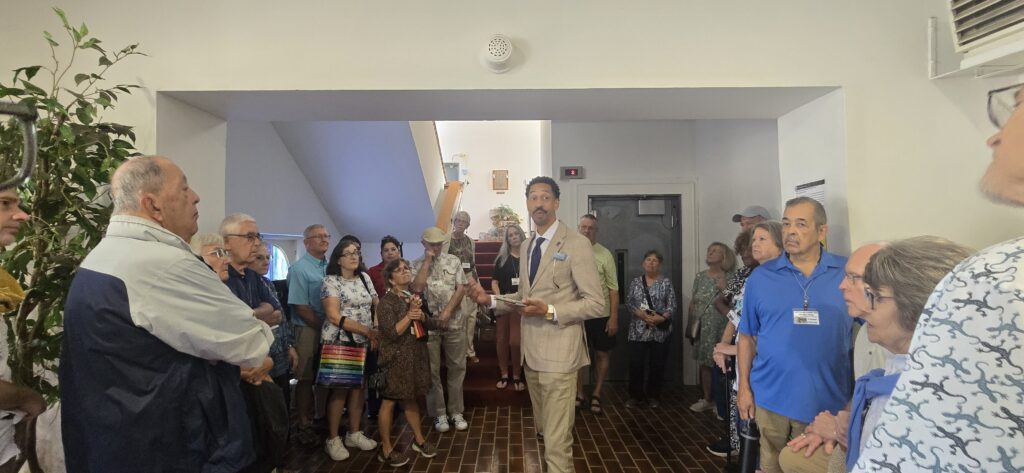
First of all, we commend Dan Koon, Kimberly Heindl, and Charlie Derrick, our wonderful Bus Driver, along with Capital Tours for such a well planned and comfortable tour. We were able to enjoy our ride and visit places in Atlanta we had always wanted to visit, but never took the time to appreciate.
We both grew up in Lexington and graduated from a segregated Lexington High School in the mid 60’s, thus the Civil Rights Movement and Vietnam War dominated early adulthood. We are lifelong Lutherans, and our church and our family have always been the heart of our daily lives. Thus, the events of Martin Luther King’s movement and the Presidency of Jimmy Carter were familiar to us.
Nevertheless, we each discovered things we did not recall in the national Center for Civil and Human Rights and in the Jimmy Carter Presidential Library. We found both museums meaningful reminders of how our country dealt with racial injustice in the 60’s and 70’s, and thus question why our country has not maintained that progress. This remains a difficult question.
Conversations with participants on the tour were most meaningful and we feel our participation in this experience has opened our eyes to the fact that we are not alone in our struggle to understand current racial injustice. While this gives us some comfort, it also gives us personal frustration.
We have been blessed to travel the world and serve the Lutheran Church in Tanzania. These blessings have enriched our faith. As we grow older and less able to be as active as we want, we try to think young and live our lives knowing we are constantly setting examples of which we are often unaware.
We consider our recent tour with a wonderful group of people to be among our many blessings. We hope it will create more conversation and service within our Lutheran Church Family. Thank you for the opportunity.
Jaime Lleras
(picture: gifts for grands)
On Tuesday morning, September 15, 2026, my wife, Pat, and I met with a group of 33 wonderful Lutheran folks from throughout South Carolina at the Capitol Tours location. Our group consisted of bishops, pastors, lay members, and spouses.
Around 8:00 a.m., after coffee, greetings, and prayer, we boarded the bus, driven by Charlie, and headed southwest toward Atlanta to begin our journey. This pilgrimage was organized by the South Carolina Synod and its Inclusiveness Network.
During the ride, we introduced ourselves and received instructions and information about our itinerary. Since I was new to the group and this was my first trip, I was also introduced to Jackie & The Destroyers, a Lutheran musical group consisting of four Lutheran pastors. Their lead vocalist, “Jackie,” led us in singing several wonderful gospel songs.
As the trip began to become more interesting to me, something special happened. It seemed as though we had all been together for months, if not years. These 30-plus people made me feel right at home, and I began to understand even more why we were on this journey together.
Each of us were handed a slip of paper with four questions:
- What stood out to me today?
- What surprised me?
- What will I carry with me?
- How has God been moving me today?
We were asked to ponder these questions and eventually share our responses.
National Center for Civil and Human Rights
Around 2:00 p.m., we arrived at the National Center for Civil and Human Rights for a self-guided tour. The museum presented the events, struggles, and achievements of the American Civil Rights Movement of the 1960s and showed how that movement helped inspire the broader global human-rights movement.
Unfortunately, we still see unnecessary hatred and division around us today.
As a child growing up in New York City, I witnessed the riots of the 1960s in and around my neighborhood. At the time, however, I viewed what was happening primarily as conflicts between police and Black protesters and rioters. I also remember hearing about the historic March on Washington.
Seeing the photographs, stories, and personal accounts at the Center gave me a much deeper understanding of what was really taking place during that period in our nation’s history.
After leaving the Center, we traveled to the famous Mary Mac’s Tea Room, where we enjoyed a wonderful dinner. Afterward, we headed to our hotel for an evening of reflection and rest following such a long, emotional, and educational day.
Martin Luther King Jr. National Historical Park
After breakfast Wednesday morning, we checked out of the hotel and headed out for another day of experiencing our nation’s Civil Rights history.
Our next stop was the Martin Luther King Jr. National Historical Park and Center. When we arrived at the memorial park, I immediately felt goosebumps as I looked at the many stories, statements, photographs, and historical displays. It was an overwhelming experience.
I believed I had already learned about the Civil Rights Movement in our country, but this visit gave me a much deeper understanding of the struggles that so many of our Black brothers and sisters endured during this tragic period in American history. I was deeply touched by what I saw and read, and it enhanced my understanding of this painful part of our nation’s history.
The tomb of Martin Luther King Jr. and his wife, Coretta Scott King, the Eternal Flame, and Freedom Hall are must-see experiences. Standing there, you truly appreciate the tremendous sacrifices and contributions that Mr. and Mrs. King made toward bringing much-needed change to our country. One interesting fact I learned was that I had always associated Dr. King with Montgomery, Alabama, when in fact Atlanta, Georgia, was his hometown and the center of so much of his life and ministry.
Ebenezer Baptist Church
Our next stop was historic Ebenezer Baptist Church, which was built in 1914 and has been restored to reflect its appearance during the 1960s. While there, a U.S. Park Ranger gave us an informative and powerful presentation about the church, where Dr. King’s father and grandfather preached, and about its important place in the Civil Rights Movement.
We also learned about the tragic death of Dr. King’s mother, Alberta King, who was killed while attending services at Ebenezer Baptist Church in 1974. The new Ebenezer Baptist Church, known as the Horizon Sanctuary, was completed and dedicated in 1999.
Jimmy Carter Presidential Library and Museum
Our final stop on this pilgrimage was the Jimmy Carter Presidential Library and Museum. We were able to take a self-guided tour, listen to stories, view photographs and gifts, and learn more about significant events during President Carter’s administration, including the Camp David Accords and his Nobel Peace Prize. We were also able to walk through a full-size replica of the Oval Office. This is another must-see museum!
President Jimmy Carter’s work and public life included a strong emphasis on human rights, and the museum provided an opportunity to learn about the accomplishments and challenges of his presidency.
MY REVELATION
I truly enjoyed spending this uninterrupted time with such a wonderful group of people and having an open mind and heart as I learned more about civil rights and the injustices that so many people experienced.
Growing up as a child in the inner city of New York, I didn’t experience or understand these issues in the same way I do today. If racial issues existed around us, we didn’t necessarily notice them because we went to school together and played together in our mixed neighborhoods without constantly thinking about race. I really didn’t understand the depth of the racial issues in the South until years after I joined the military. Even then, my personal experiences did not seem as significant to me.
It wasn’t until I moved to the Washington, D.C., and Virginia area in the late 1990s that I personally experienced situations that caused me to better understand racism and civil-rights concerns.
Fortunately, I continued to rely on the values I learned from my parents and the discipline instilled in me through my military service. I dealt with those experiences as best I could and continued moving forward.
Today, as a retired senior citizen, I can only hope that our Good Lord gives me the strength, wisdom, and courage to become more involved and help improve this journey toward greater understanding, respect, and equality.
Standing at the tomb of Dr. Martin Luther King Jr. and Coretta Scott King, seeing the Eternal Flame, and visiting Freedom Hall was an experience I will never forget. Being there gave me an even greater appreciation for what Mr. and Mrs. King did for the much-needed movement for civil and human rights in this country.
Another interesting realization for me was discovering how strongly Atlanta was connected to Dr. King’s life and ministry. I had always associated him primarily with Montgomery, Alabama.
The Four Questions
What stood out to me today?
The visit to the National Center for Civil and Human Rights stood out to me very strongly. It reminded me that civil-rights issues still exist today.
However, it also reminded me that improvement begins with each of us — with how we respect one another’s rights, how we treat each other, and how we continue working toward living together as ONE.
What surprised me?
What surprised me most was the reality of the Freedom Rides through the South. I had heard about them before, but seeing the photographs, stories, and personal accounts at the Civil Rights Center hit me like a brick.
It touched me deeply. It hurt my soul and made me reflect on my own past, even though I once thought these events didn’t really involve me. I truly wish I had visited this Center years ago.
What will I carry with me?
After experiencing and learning more about the many struggles of the early 1960s, I realized the meaning behind one statement I saw:
“I am Someone.” And so are others.
The first day of this journey will always be a part of me. I will carry these experiences with me, and I will share them with others.
How has God been moving me today?
God has opened my eyes and my heart to help those in need, especially when it comes to civil and human rights. He has reminded me that we are all His children and that we have a responsibility to treat one another with dignity, respect, and love.
After everything I had experienced during this Civil Rights Journey, those words really hit home.
Final Reflection
Overall, Pat and I truly enjoyed being part of this South Carolina Synod Civil Rights Journey.
It was much more than a refresher course in history. It was a living experience — an opportunity to revisit the many struggles surrounding civil and human rights and to look at that history through new eyes. I began this journey thinking I was going to learn more about history. I left feeling that I had also learned something about myself.
And perhaps most importantly, I was reminded that the journey toward understanding, respect, equality, and human dignity is not simply something we read about in history books.
It is a journey that continues — and each of us has a part to play.
It’s funny how things happen.
In my Thursday, September 17 devotional reading, I came across this statement:
“There’s no US and THEM — only US, children of God.”
Amen.